For many decades it was believed that the Chapel coincided with the ancient small church that Duke Emanuele Filiberto - having moved the capital of the duchy to Turin (1563) and waiting to be able to build the large church promised at the battle of San Quintino - immediately wanted to dedicate to San Lorenzo, also giving it importance as the first location of the Holy Shroud transferred in 1578 from Chambery, to facilitate the pilgrimage of the Archbishop of Milan San Carlo Borromeo (commemorated in the plaque to the right of the entrance door). Instead, according to the data highlighted by scholars starting from an important research published in 1999, the first, temporary, ducal Chapel of San Lorenzo probably corresponded to an ancient small church adjacent to the surrounding walls, at the height of the garden of the Palace.
The Chapel of Our Lady of Sorrows derives from the closure of the three-arched portico which, since the mid-17th century (before the construction of the large church), was open towards the square, in continuity with the front of the other buildings.
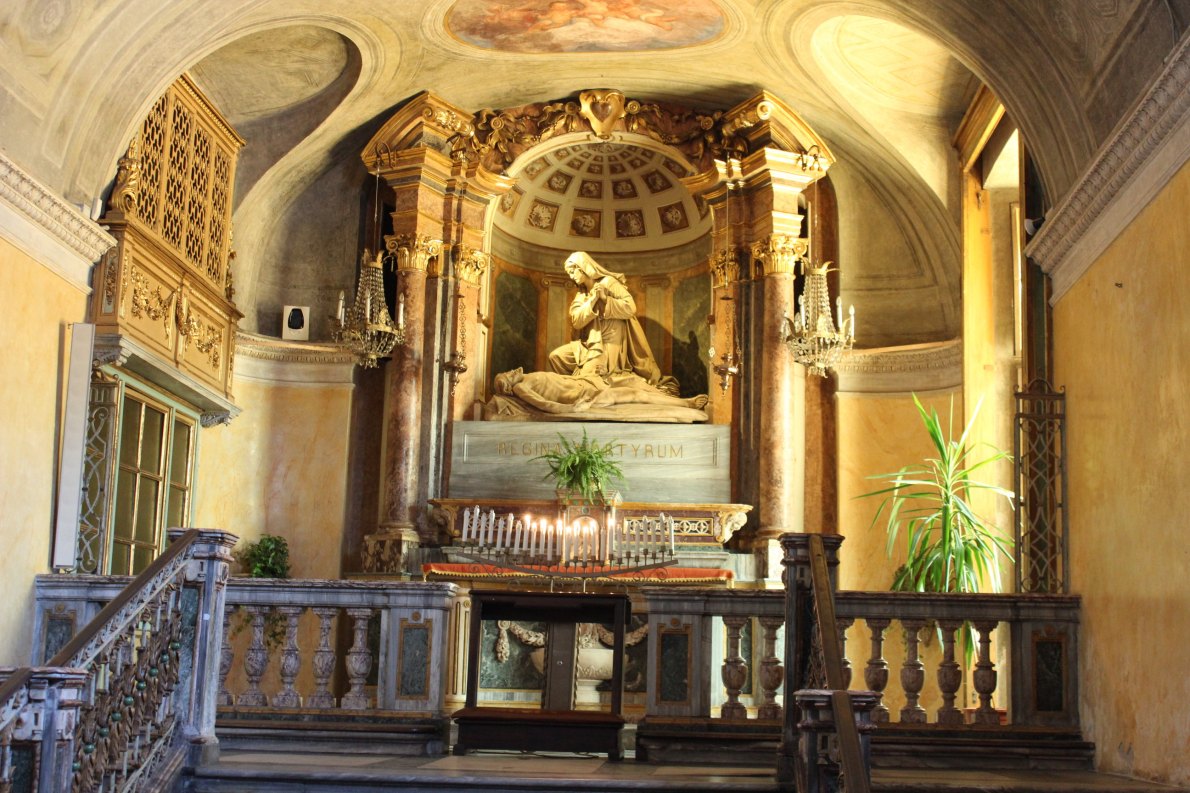
The altar and the Holy Stairs (12 steps to climb on your knees), the work of Bernardo Antonio Vittone, date back to the mid-18th century.
In 1846 the Chapel, or Oratory, of the Addolorata was definitively arranged by the architect Alfonso Dupuy.
In the vault there are frescoes on the theme of the Holy Shroud; on the wall there are 17th-century paintings on the theme of the Passion; on the left, above the secondary entrance door, an 18th-century organ that is still in working order.
On the altar there is the wooden group of the Addolorata, representing the Holy Virgin kneeling over the dead Christ, the work of the sculptor Giovanni Tamone (1870).